
October 21st will be Heat Pump day. The initiative was born from the European Heat Pump Association, a company representing the heat pump sector in Europe, which in 2024 decided to establish a day dedicated to heat pumps.
Heat Pump day returns this year as the international scene looks at this technology with ever greater interest. Canale Energia joined Paul Kenny, general director of the Association, to learn about this year’s initiatives and the preparation one month before the anniversary.

This is the second edition, but I would like to ask you how the need to establish a heat pump day arises? What numbers are we talking about in terms of supply chain and direct working positions when we refer to electric heat pumps?
Did you know that more than 50% of Europe’s energy consumption goes into heating and cooling? It’s a huge share of our energy demand, and yet often overlooked. We felt the need to dedicate a day to heat pumps because they can provide home comfort – heating as well as cooling – while cutting energy use, reducing emissions that harm health and the climate, boost our energy independence by replacing fossil fuels, and create local jobs!
And that’s not to mention large heat pumps which can reach industrial process temperatures of as much as 200°C, helping industry decarbonise too! At the European Heat Pump Association, we observed that a lot of efforts were being made by different stakeholders across Europe—manufacturers, installers, policymakers, research institutes, and end-users. But they were scattered. That’s why we decided to create Heat Pump Day—a common platform to bring everyone together, amplify initiatives, and create a real community around this technology.
In terms of impact, today we estimate that over 433,000 people work indirectly and directly in the heat pump sector across Europe, with around 300 manufacturing sites. And the sector is growing fast: we will need many more skilled professionals—installers, engineers, and experts—to fully unlock its potential.
Electric heat pumps represent an opportunity to decarbonise consumption. From your privileged observatory across different countries, what is the response towards this technology? And where do you see limitations or strengths?
The response is very encouraging. We see heat pumps being embraced in many European countries as a key solution to achieve climate neutrality, reduce dependency on fossil fuels, and lower household energy bills. Governments are increasingly supporting their uptake through incentive schemes, regulatory frameworks, and awareness campaigns.
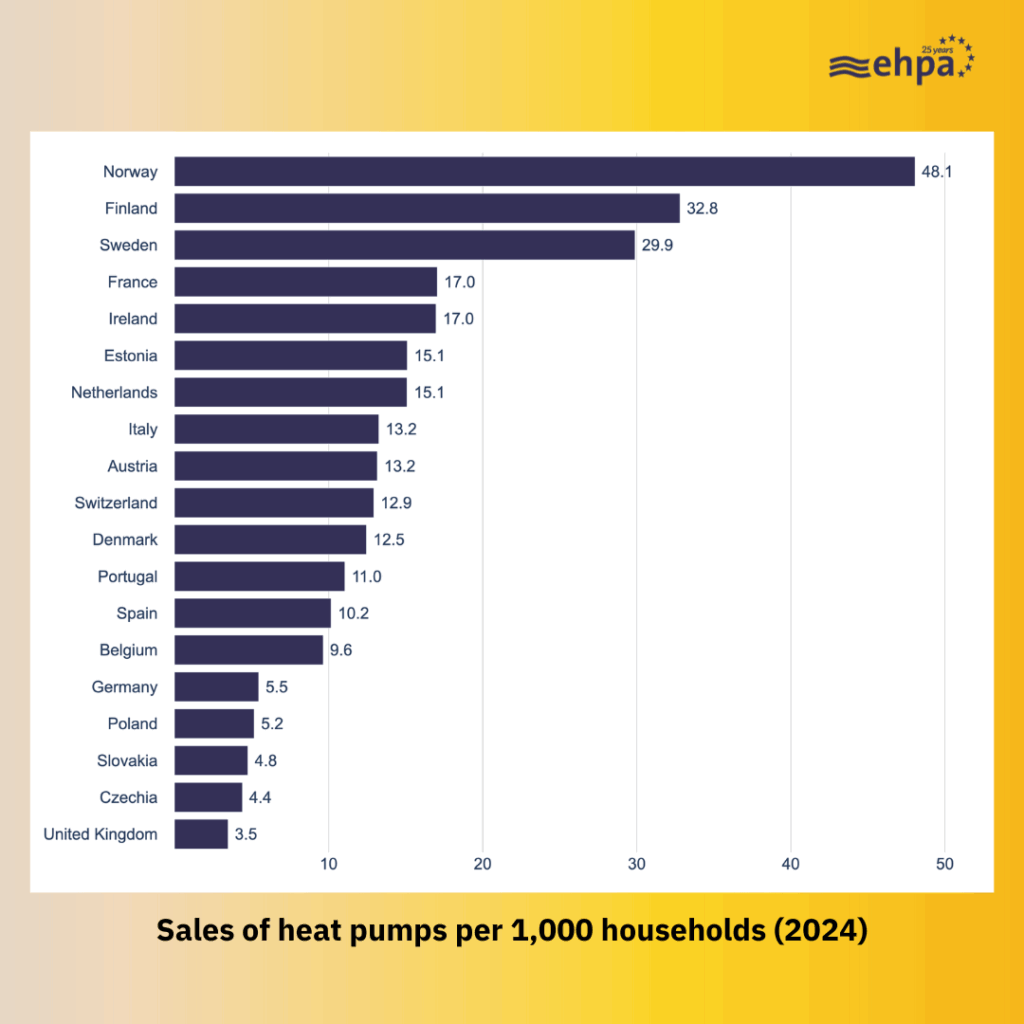
That said, the speed of adoption varies. Some markets are more advanced—like the Nordics, where heat pumps are already mainstream—while others are still at the beginning of the journey. Our recent analysis showed that in leading countries, the number of installed heat pumps per capita is as much as 14 times higher than in less developed markets, showing the huge potential. The main strengths of the technology are clear: they are highly efficient, they run on electricity that is increasingly renewable, and they improve air quality because they don’t burn fuel locally.
Limitations, however, include the need for more trained installers, the upfront cost which can be a barrier for some households, the electricity price – which is often well over twice the price of gas, making heat pumps more expensive to run despite their efficiency, and the importance of clear, consistent – and clearly communicated – policies to give confidence to both consumers and industry.
Do you think there are any strengths not yet explored? If so, which ones?
Yes, absolutely. One of the less-discussed strengths of heat pumps is their role in the wider energy system. Beyond heating and cooling buildings, heat pumps can also be used in industry, in district heating networks, and even in recovering waste heat from data centres or factories.
Another unexplored potential is their ability to support the electricity grid. Because heat pumps can be smart and flexible, they can adapt their consumption depending on the availability of renewable energy, making the whole system more stable and sustainable. This is a game-changer in the energy transition.
I would conclude by asking you what the main events and activities are for this day, and how to stay updated.
This year we already have more than 25 events across Europe listed on our event map, and the number is growing every week. We are working closely with our national associations to gather initiatives ranging from conferences and workshops to open-door events at factories, installer trainings, and awareness campaigns.
To stay informed, I would encourage everyone to follow us on social media—on Instagram and LinkedIn—where we are very active. Throughout October we will be posting daily content to build up to Heat Pump Day.
And of course, our dedicated website is the central hub. There you’ll find resources, videos, fun and interactive content like our heat pump quiz, and the full event map. If anyone is planning an activity related to heat pumps, we would be delighted to feature it on the site and share it with the community.

Per ricevere quotidianamente i nostri aggiornamenti su energia e transizione ecologica, basta iscriversi alla nostra newsletter gratuita
e riproduzione totale o parziale in qualunque formato degli articoli presenti sul sito.